ua

ua

Sunday, February 02, 2020

Porcupine Tree: The Sky Moves Sideways (UK Version) 1995


The Sky Moves Sideways was the first Porcupine Tree album to be released in the US (albeit with an altered track list), and the first on which Porcupine Tree was actually a band rather than simply a pseudonym for Steven Wilson.


This transition took place while the album was being recorded, so two of the tracks – namely “The Moon Touches Your Shoulder” and “Dislocated Day” – are performed entirely by Wilson, while the full band appears on the remainder of the album (including “Stars Die”, a UK single which was added to the US version of the album). In 2004, a new, two CD version of the album was released, featuring newly recorded drums by Gavin Harrison on these two tracks.


There are thus three distinct versions of this album – the original UK version, the US version, and the 2004 remaster – no two of which feature the same track list, or the same version of “Moonloop”.

The Sky Moves Sideways was the first Porcupine Tree album to be released in the US (albeit with an altered track list), and the first on which Porcupine Tree was actually a band rather than simply a pseudonym for Steven Wilson. This transition took place while the album was being recorded, so two of the tracks - namely "The Moon Touches Your Shoulder" and "Dislocated Day" - are performed entirely by Wilson, while the full band appears on the remainder of the album (including "Stars Die", a UK single which was added to the US version of the album). In 2004, a new, two CD version of the album was released, featuring newly recorded drums by Gavin Harrison on these two tracks.


There are thus three distinct versions of this album - the original UK version, the US version, and the 2004 remaster - no two of which feature the same track list, or the same version of "Moonloop".


Wilson remixed elements of "The Colour of Air" for use in the track "Fuse the Sky" during the Signify era on an ambient compilation; it later appeared on Stars Die: The Delerium Years 1991–1997. The guitar progression of "Spiral Circus" would be reused by Wilson project No-Man for "Something Falls," a b-side for their 2001 album Returning Jesus.


( AllMusic Review by Ned Raggett

Though Porcupine Tree's permanent lineup was in place by the time Sky Moves Sideways was complete, it was actually a combination of old and new, with a number of tracks once again done by Wilson on his own. Regardless of the provenance of one song or another, though, it was another fine release under the Porcupine Tree name, continuing the excellence of Up the Downstair while achieving a new liquid sense of drama and overall flow.


Barbieri's keyboard skills alone made for a wonderful addition to the ranks, easily capturing the slow sense of unfolding atmosphere and elegance combined from earlier Porcupine Tree work while adding his own touches here and there, a touch of playfulness and improvisation. The Edwin/Maitland rhythm section sound like they were born to work together, able to both set slow, spacy moods and quick gallops and dance-skewed approaches both.


Wilson, meanwhile, is still himself, calling to mind strange lyric images of rural collapse and romantic connection in his ever stronger, commanding but never straining vocals. As for guitar, there's subtle delicacy and headbanging overload and plenty of space in between for more. Overall, there's not much in the way of immediate sonic difference from Up the Downstair, more a sense of exploring and establishing styles, almost as if the bandmembers were getting used to working with each other.


The tripped-out title track bookends the album (perhaps in a not so subtle nod to a similar sequence on Pink Floyd's Wish You Were Here with "Shine on You Crazy Diamond"). The real winners, though, are the jazz-touched acoustic/electric dreamscape of "Stars Die," with a great lead melody and overdubbed chorus from Wilson, and the immediately following "Moonloop," an instrumental calm then rocking jam that's credited to all four members.)

TRACKS

1.   "The Sky Moves Sideways Phase 1"
I.   "The Colour of Air"
II.  "I Find That I'm Not There"
III. "Wire the Drum"
IV.  "Spiral Circus"    18:37
2.   "Dislocated Day"    5:24
3.   "The Moon Touches Your Shoulder"    5:40
4.   "Prepare Yourself"    1:54
5.   "Moonloop"    17:05
6.   "The Sky Moves Sideways Phase 2"
I.   "Is...Not"
II.  "Off the Map"    16:46

Total length:  65:31

Steven Wilson: vocals, guitar; keyboards, tapes, programming and mix engineer
Colin Edwin: bass
Richard Barbieri: keyboards; electronics, programming
Chris Maitland: drums

Additional Musicians:

Ricky Edwards: additional percussion
Theo Travis: flute on “The Sky Moves Sideways Phase 1”
Suzanne J. Barbieri: vocals on “The Sky Moves Sideways Phase 2”
Gavin Harrison – drums on “Dislocated Day” and “Moon Touches Your Shoulder” (2004 expanded remaster only)

Released: 30 January 1995
Recorded: June 1993 - July 1994
Genre: Progressive rock, space rock, psychedelic rock
Length:    65:31
Label: Delerium
Producer: Steven Wilson

THE SKY MOVES SIDEWAYS (Phase One)  LYRICS   


We lost the skyline
We stepped right off the map
Drifted in to blank space
And let the clocks relapse

We laughed the rain down
Slow burn on the lawn
Ghosts across the lawn
Swallowed up the storm

Sometimes I feel like a fist
Sometimes I am the color of air
Sometimes it's only afterwards
I find that I'm not there

In the dream dusk
We walked beside the lake
We watched the sky move sideways
And heard the evening break

Sometimes I feel like a fist
Sometimes I am the color of air
Sometimes it's only afterwards
I find that I'm not there

DISLOCATED DAY  LYRICS   
   

A dislocated day
Peers in to the ether
Counts the stars inside the sky
And flies in to the never

Looped around my eyelids
A thousand shining flecks
Pale against the canvas
Which hangs around my neck

Dislocated day
I will find a way
To make you say

The name of your forgiver
Stood beside an inlet
A starfish leads a dance
It dreams it is a human
And falls into a trance
A hole inside my body

Is wired up to a charge
Chemical imbalance
Tells me who you are
Insects hide the silence

November brings deep rain
Between the flow to freezing

Friday, January 31, 2020

Jodorowsky - Joran Janjetov: Before The Incal - The Incal - Final Incal


JODOROWSKY

Jodorowsky started his comic career in Mexico with the creation of Anibal 5 series in mid-1966 with illustrations by Manuel Moro. He also drew his own comic strip in the weekly series Fabulas pánicas that appeared in the Mexican newspaper, El Heraldo de México. He also wrote original stories for at least two or three other comic books in Mexico during those days: Los insoportables Borbolla was one of them. After his fourth film, Tusk, he started The Incal, with Jean Giraud (Mœbius).

 
This graphic novel has its roots deep in the tarot and its symbols, e.g., the protagonist of The Incal, John Difool, is linked to the Fool card. The Incal (which would branch off into a prequel and sequel) forms the first in a sequence of several science fiction comic book series, all set in the same space opera Jodoverse (or "Metabarons Universe") published by Humanoids Publishing.


Comic books set in this milieu are Incal (trilogy: Before the Incal/ Incal/ Final Incal), Metabarons (trilogy: Castaka/ The Caste of the Metabarons/ Weapons of the Metabaron), and The Technopriests and also a RPG adaptation, The Metabarons Roleplaying Game. Many ideas and concepts derived from Jodorowsky's planned adaptation of Dune (which he would have only loosely based upon Frank Herbert's original novel) are featured in this universe.


ZORAN JANJETOV

Zoran Janjetov (Serbian Cyrillic: Зоран Јањетов; born June 23, 1961) is a Serbian comics artist. Janjetov is among most prominent comics creators of former Yugoslavia, published worldwide. He is best known as the illustrator of Avant l'Incal and The Technopriests, written by Alejandro Jodorowsky.


During the mid-1980s, Janjetov was a vocalist for the Yugoslav art rock band Heroina, with which he recorded one album.


Janjetov started to draw at very early age with strong support from his parents. His father, an architect by profession, gave him the knowledge needed to start his career. Young Janjetov was influenced by the works of Walt Disney, and had already made his first short comic at age seven.
After finishing high school, he continued his education at the Academy of Arts in Novi Sad, where he graduated.


From 1981 to 1995, Janjetov worked on the Bernard Panasonik, published in magazines Yu strip magazin and Vreme zabave.
In 1986, Janjetov was chosen by Moebius to continue his work The Incal.


Before the Incal

The story is a considerably more straightforward noir tale of boundless urban corruption with the relative absence of spiritualistic elements, which dips deeper into exploring the urban fabric of the world of The Incal. The story follows young DiFool living in demimonde.


He soon finds that his prostitute mother devoted herself to growing amorine, a drug that restores the ability to love. His father, Olivier DiFool, breaks the law in wearing a fake halo that is the mark of an aristo.


Justice is harsh for such transgressions of class — a legal clause "allows the condemned man to choose between a tablet at the morgue-wall, where he'll sleep away his thirty-year-and-one-day term", or "remodeling", which means having his entire memory wiped.


His father chooses remodeling. DiFool soon begins to investigate the mystery of disappearance of the children of prostitutes, something he shouldn't find out.


The Incal

The story is set in the dystopian capital city of an insignificant planet in a human-dominated galactic empire, wherein the Bergs, aliens who resemble featherless birds and reside in a neighboring galaxy, make up another power bloc.


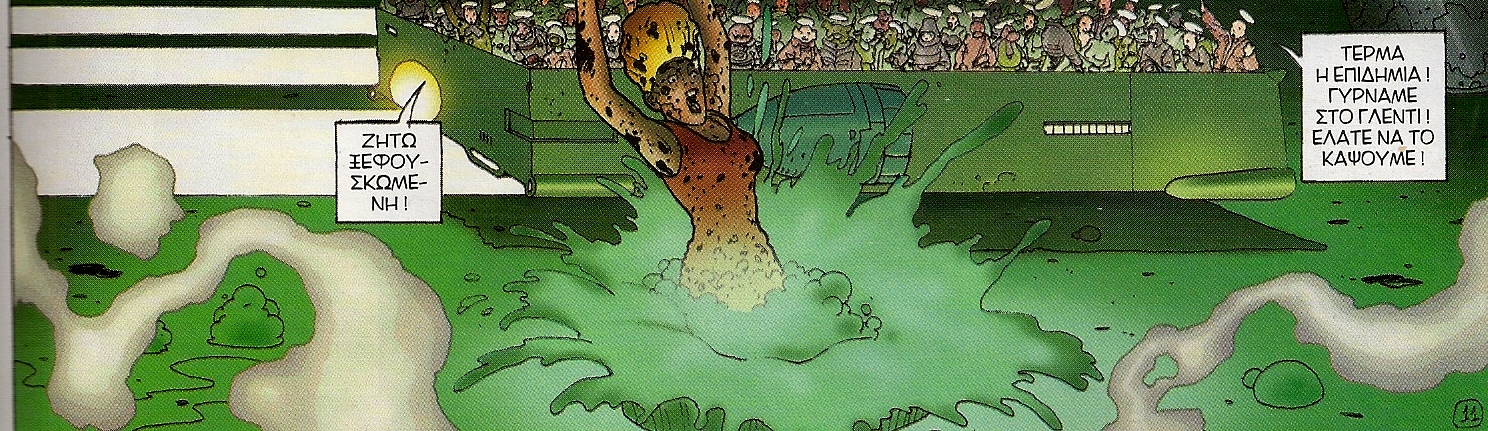
It starts in medias res with DiFool thrown from the Suicide Alley to the great acid lake below by a masked group, luckily saved by a police cruiser.


During the questioning he denies that he received the Light Incal, a crystal of enormous and infinite powers (it guides and protects those who believe in it), from a dying Berg. The Incal is then sought by many factions: the Bergs; the corrupt government of the great pit-city; the rebel group Amok (led by Tanatah); and the Church of Industrial Saints, commonly referred to as the Techno-Technos or the Technopriests, a sinister technocratic cult which worships the Dark Incal.


Animah (an allusion to anima), the keeper of the Light Incal, seeks it as well. During the journey DiFool and Deepo are joined by Animah, The Metabaron, Sunmoon, Tanatah (sister of Animah) and Kill Wolfhead, with a task of saving the universe from the forces of the Dark Incal, and the Technopriests manufacture and launch into outer space the sun-eating Dark Egg.


As the darkness is overcome, DiFool is brought before Orh, the fatherlike divinity, who tells him he must remember what he witnessed.


As DiFool falls away, he finds himself where he was at the beginning, falling down the shaft.


Final Incal

The story from the unfinished After the Incal was rewritten to provide a separate narrative for this volume. The story starts after The Incal climax, in which John DiFool encountered a flowing-bearded divine being named Orh, witnessing a universe-shaking event, hurtling towards certain death in the acid lake. DiFool forgets about the cosmic encounter, and recovers his memory as the universe faces a threat of a metallic virus.


The Prezident was cloned in a metallic body, equipped with both chemical and brutal weapons, but also an altered mind — operating under the influence of the "destroyer of all living things", the Bentacodon (equivalent to The Incal's Black Egg). He unleashes a destructive organic virus called the Biophage 13-X with the purpose of forcing the population to abandon their natural bodies in favor of robotic ones.


The only way to counteract is to reunite John DiFool with his true love, Luz de Garra (from Before the Incal), and the Elohim (a force of goodness) makes four John DiFools from different realities to encounter each other on a quest to find her.


The egos of the allegedly evolved guru DiFool and the super-evolved "angelic" DiFool are ridiculed, and the least enlightened DiFool, the ugliest and most craven, is selected to save the universe.


In the end, the cosmic humanity manages to become one collective consciousness, as true love saves it from turning into a collection of unfeeling metallic beings.


Main characters

    John DiFool, protagonist: a Class R licensed private investigator and occasional bodyguard. DiFool is reluctant to assume the role of hero, and suffers mood swings, self-doubt, and temper tantrums. He has a fondness for cigars, "ouisky", and "homeosluts" (gynoid prostitutes). He is an everyman character, both unusually damning and praising of the human condition, kindly, sacrificing and selfish, likely to run away.[15] His story is presented in "Before the Incal": he is the son of a prostitute, and started as a PI while investigating on the children of the red ring prostitutes.

    Deepo, DiFool's loyal and good-hearted "concrete seagull"; generally smarter and more resourceful than John himself. Early in the story, the Light Incal gives him the power of speech.

    Animah and Tanatah, two sisters charged with guarding the Light and Dark Incals, respectively, whereof Tanatah hired the Metabaron to kill John DiFool and obtain the Light Incal. Animah, mother of Sunmoon, who originally safeguarded the Light Incal, has psychic powers. Tanatah is also the head of the rebel group called the Amok.

    The Metabaron, the greatest bounty hunter, mercenary, and fighter ace in the known universe, and the adopted father of Sunmoon; originally sent to kill John DiFool by Tanatah. The Metabaron returned John in a frozen state without killing him, knowing that Tanatah would betray him.


    Sunmoon or Solune
(French words soleil and lune), the adopted child of the Metabaron and the biological child of Animah and John DiFool. Like Animah, Sunmoon has immense psychic powers, and was the chosen host of the power known as the Incal and become the dual-gendered leader of the universe.


    Kill Wolfhead, an anthropomorphic wolf mercenary in Tanatah's employ. Kill holds a grudge against DiFool, who pierced his ear with a bullet near the beginning of the story. He is featured as faithful, loyal, impulsive and aggressive.

 
"I dreamed I was flying in intergalactic space. A cosmic being formed by two superimposed pyramids, one black, the other white, was calling me. I moved toward it and found myself submerged in the center. We exploded. And that’s how my subconscious mind introduced me to “El Incal”."

— Jodorowsky on the Incal.


The center of the concept is DiFool's fantastic spiritual journey (or initiation) on a cosmic scale, which he is reluctant to accept; he constantly wishes to return to his own ignorant reality of simple hedonistic pleasures.


It is an allegory for the sins repeating, the futility of complacency and the necessity for individual transformation. As the story progresses he keeps changing, becoming more heroic, even physically more handsome.


The original six installments begin and end by DiFool falling from the bridge; he descends, ascends and later re-descends in "closed" circularity.


The universe is split into two galaxies, a human (with 22,000 planets), and a Berg (featherless birdlike aliens), and the story is set on four planets in the human galaxy: Ter21, Techno-Gea, Aquaend, and the Golden Planet.


On the planet Ter21 there are two social classes: the fortunate (common and aristocrats), who reside at the top, and the others (including the mutants led by Gorgo the Foul, who represent the poor living in misery, on the fringes of society, minorities of all kinds), who live down in the pits.


At the top, it's a near-panopticonical dystopia with standard TV program (with the same presenter Diavaloo) depicting filmed violence for public consumption, and indoctrination.


Seemingly no one works anymore, and all life is mediated through the TriD (TV), even people's dreams.


People are addicted to "love drug" amorine, while the president is engaged in repeated body transplants. The masculine role is ridiculed by mass-produced holographic prostitutes. The technopriests represent the most damning, avaricious human drives.


John DiFool is based upon The Fool from tarot with his name being a pun upon "John, the Fool". Animah's name is based on the Jungian concept of the anima, the feminine part of every male's psyche, as well in Latin "anima" means "psyche".


The series has no taboos, an attitude towards sex, violence and general social stigmas that may be avoided in more conventional comics. They include Black-and-white dualism or the conflict between good and evil, mystical symbolism, archetypes, metaphysics, tarot and other influences.


In the story there's often a conflict between life or nature and dead technology (even uniformity and diversity), as "glasses enable you to see, that's technology. But happiness is not that, it's not your glasses. It's what you are able to see.


If you have wonderful glasses but don't know how to see what's in front of you, then that technological tool is useless". The series also showcases religion, economy, politics and warfare, all mixed together.


The Final Incal is kind of a call for revolt to organize life in a different way, because as individuals people are mortal, but as humanity itself they are immortal.


To learn that others exist, to live together and give, that there is continuity only as part of humanity as a whole. It demonstrates that "love is the ultimate purifier; a force that can cleanse, renew and revitalize".